
Worklife Expectancy’s Blind Spot: How Remote Work Affects Lost Earning Capacity
October 25, 2026
Introduction
Economists are often called upon to calculate future earnings for an individual who has suffered injury or death. When dealing with an adult with a sufficient work history, previous earnings can be used in calculations. However, when dealing with a child, student, or someone who hasn’t worked before, no such records exist. The expert can then use population statistics to determine how far individuals with a similar background will typically go into education, what they will earn, how quickly they will earn, and how long they will stay economically active. The majority of these statistics are published separately by gender, and some are also separated by race and ethnicity.
Over the last decade, there has been policy debate regarding whether demographic-specific statistics should be used. There have been bills proposed in Congress and multiple states to prohibit any reduction in damages based on race, ethnicity, or sex. California has had such a law in place since 2020. In response to this, forensic economists have engaged in significant research to determine what difference these demographic-based estimates have on damages modeling.
Where demographic statistics enter the calculation
A lost-earnings estimate projects a stream of future earnings. In its simplest form, the expert needs a starting level of earnings, a rate at which those earnings are expected to grow, and the number of years over which the loss extends.1 In the absence of a sufficient work history, each of these inputs can be drawn from tables that may differ by gender, and some of them by race or ethnicity. Starting earnings are often taken from Census or American Community Survey tabulations by gender and education; earnings growth from age-earnings profiles estimated separately for men and women; and the length of the loss from worklife expectancy tables, which in their most widely used form are published by age, gender, and education.2
The question is more important when the plaintiff is a minor child. Because a child has no earnings history, the probability that the child would have reached each level of education is typically estimated with a model that relates attainment to family background, and then applies average earnings for each level.3,4 These attainment models have traditionally included race and ethnicity among their explanatory variables. Life expectancy, which determines the duration of a life care plan or of lost household services, and personal consumption are also commonly taken from gender-specific tables. A rule that requires neutral statistics therefore touches more than one input, and the inputs do not all move in the same direction.
The legislative background
The use of race- and gender-specific tables in economic damages was debated in the legal field well before it reached legislatures.5,6 In 2008, a federal judge in the Eastern District of New York declined to rely on race-based life and worklife figures in McMillan v. City of New York.7 The issue gained wider attention in 2016, when The Washington Post published articles arguing that girls and minority children received smaller awards than otherwise similar plaintiffs because experts relied on group-specific data.8 These articles cited a 2009 survey of forensic economists in which 44% of respondents said they would use both race- and gender-specific data for a child.9 In December 2016, the Fair Calculations in Civil Damages Act was introduced in both chambers of Congress. It would prohibit federal courts from awarding damages based on projections that take into account race, ethnicity, gender, religion, or sexual orientation, and it directed the Secretary of Labor to develop guidance for neutral earnings tables. The bill did not pass, and versions of it were reintroduced in 2019, 2023, and most recently in June 2025.10
At the state level, California enacted Senate Bill 41 in 2019. The resulting Civil Code §3361, in effect since January 1, 2020, provides that damages for lost earnings or impaired earning capacity in personal injury and wrongful death cases “shall not be reduced based on race, ethnicity, or gender.”11 New Jersey’s legislature passed a similar bill in December 2021, covering race, ethnicity, gender identity or expression, and sexual orientation.12 Comparable bills have been introduced in Maryland (2022) and New York (2023 and 2025), and a District of Columbia bill was proposed in 2020 but not brought to a vote.13,14
The statutes leave an important question open. They prohibit damages from being “reduced” on these grounds without specifying the baseline against which a reduction is measured. Practitioners have responded in different ways: some apply male data to female plaintiffs, some use statistics for the total population, and some present both sets of results and leave the choice to the court.15 The forensic literature reviewed below notes that the meaning of “shall not be reduced” is likely to remain contested.16
What the recent research finds
In 2020, the Journal of Forensic Economics devoted a special symposium to the use of race- and gender-specific statistics in litigation.17 The symposium papers, together with a handful of studies published since, approach the question from two directions. One set asks how a gender-neutral rule would change each input to a lost-earnings calculation. The other asks how removing race and ethnicity from the models used for minor children affects individual plaintiffs within each group.
Even and Macpherson (2020) note that a gender-neutral rule would, in most cases, raise projected losses for women and lower them for men, because women on average have lower earnings, shorter worklives, and lower early-career earnings growth; the one exception they identify is older workers, among whom women’s earnings growth exceeds men’s.1 They report that a large share of the gender earnings gap is associated with differences in occupation, industry, and experience, while also discussing the significant impact of discrimination.
Allen (2020) addresses the worklife component directly.18 Using the transition probabilities behind the widely used Skoog-Ciecka-Krueger tables, he constructs the first worklife expectancy tables for men and women combined. He finds that, at almost every age and education level, women leave the labor force at higher rates and return at lower rates than men, and that this divergence extends well beyond the childbearing years; women’s lower participation is accounted for mainly by time spent caring for home or family and by retirement. Applied to the total population, the combined tables give women longer worklives than the gender-specific tables do, and men shorter ones.
Spizman (2020) brings these pieces together in a case study of two infants, one female and one male, who suffer the same injury.19 The study shows that the direction of the effect depends on the input being made neutral. Gender-neutral earnings data raise the girl’s projected earnings loss and lower the boy’s, while gender-neutral life expectancy shortens the expected duration of the girl’s life care plan and lengthens the boy’s.
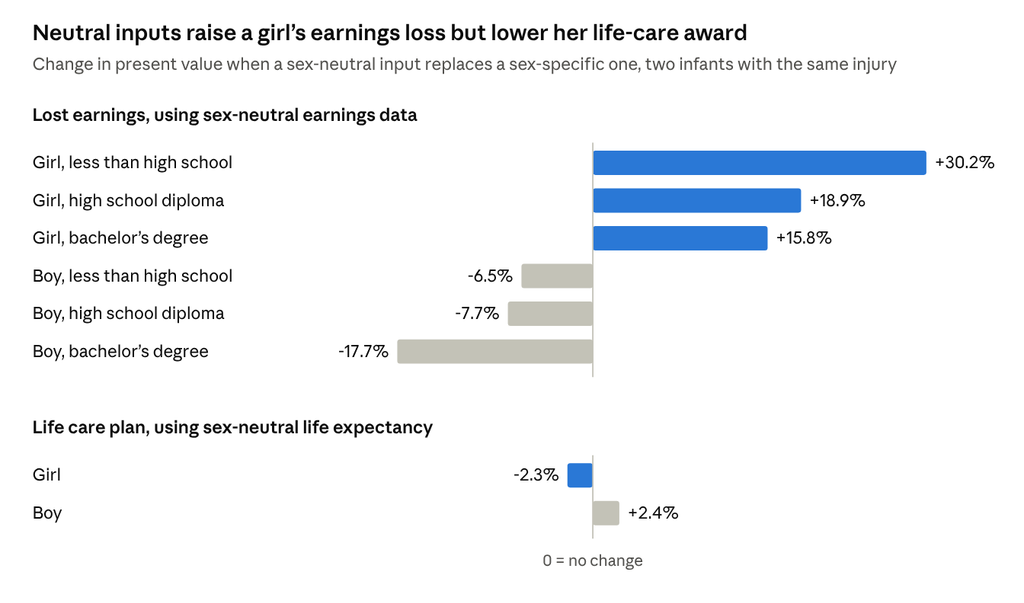
Using combined tables in Allen (2020), the girl’s worklife increases by 1.5 to 5.3 years depending on her education, and the boy’s falls by 1.7 to 4.5 years in comparison to the analogous gendered estimates. When all inputs are combined, Spizman (2020) reports that the girl’s total damages rise by less than 2% at lower education levels and by 3.66% with a bachelor’s degree, while the boy’s fall by 7.00% with a bachelor’s degree. He also observes that if a neutral rule were read to cover life expectancy, the effect on a girl’s life care award would run in the opposite direction from the effect on her earnings, and he raises the question of whether the resulting changes justify the costs of implementation and litigation.
The second strand of the literature concerns race and ethnicity, which enter damages for minor children mainly through educational attainment models. Spizman and Kane (2020) estimated an ordered probit model using the 1997 National Longitudinal Survey of Youth, and Christensen (2020) estimated a model that allows the influence of parents’ education to differ by household structure.20,21 Both include race and ethnicity among the predictors of how far a child will go in school. Spizman, Cahill, and Kane (2022) then re-estimated the Spizman and Kane (2020) model with and without the race and ethnicity terms and compared lifetime earnings for more than 3,000 combinations of family characteristics.16 They find wide variation within every racial and ethnic group: removing race and ethnicity raises projected earnings for some children in a given group and lowers them for others, because children within each group differ in family composition, income, parental education, and location.
Cahill and Spizman (2025) extend this analysis in two ways.14 Their simulations show different patterns by gender. First, they remove gender as well as race and ethnicity, so their “neutral” model ignores all three characteristics. Second, they apply group-specific earnings within each education level, not just group-specific probabilities of reaching each level. For each simulated child, they then compare projected lifetime earnings under the neutral model with projected earnings under a model that uses the child’s race, ethnicity, and gender. For boys, the results are consistent across the profiles the authors examine. The neutral model lowers projected earnings for every White non-Hispanic boy and raises them for every Black boy, Hispanic and non-Hispanic. For girls, the results depend on race and ethnicity. One might expect removing gender to raise girls’ projected earnings across the board, but it does not, because race and ethnicity are removed at the same time. For White non-Hispanic girls, the neutral model raises projected earnings in about 40% of profiles and lowers them in about 55%. White Hispanic girls mostly gain. For Black girls, the neutral model lowers projected earnings in about three-quarters of profiles for non-Hispanic girls and in every profile for Hispanic girls. The authors trace this to the attainment model: among girls, being Black is associated with higher predicted educational attainment, so removing race takes away an advantage the race-specific model would have given them. The authors therefore frame the policy question as a trade-off. A neutral rule may help a protected group on average, which the authors define as female, Black, and Hispanic plaintiffs, while lowering the projected earnings of some individuals within that group.
How practitioners use demographic factors
Surveys of forensic experts, conducted roughly every two to three years, give a sense of current practice. In the 2019 survey, respondents were asked how often they account for various characteristics when estimating worklife.22 Gender was used about as routinely as age and education, while race or ethnicity was used much less often: the median respondent reported never using race or ethnicity. The 2021 survey asked specifically about gender, “if not precluded by state law,” across five inputs to the calculation.23
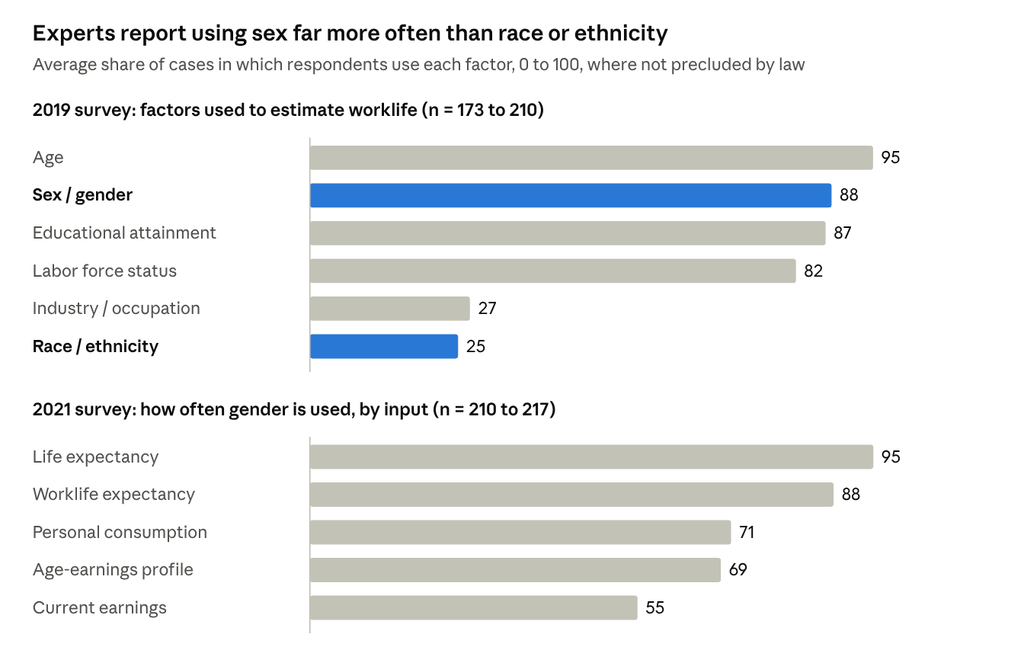
The 2021 results show that gender is not applied uniformly across a calculation. It is used almost always for life expectancy and worklife, less consistently for personal consumption and age-earnings profiles, and in about half of cases for current earnings, where a plaintiff’s own record is often available. The survey’s authors note that most respondents make gender distinctions on several inputs, in contrast to the approach required under the California statute. For comparison, the 2009 survey cited by the sponsors of the 2016 federal bill had found that 44.8% of respondents would use both race- and gender-specific data for a child, and 42.4% gender-specific data only.9
The arguments on each side
Much of the debate turns on two questions: whether demographic differences in earnings and labor force attachment reflect discrimination or other factors, and whether the purpose of a damages calculation is the most accurate forecast for the individual plaintiff or a forecast that does not carry forward group-level disparities. Even and Macpherson (2020) frame this through the economics of statistical discrimination.1 On one hand, group-specific statistics can improve the accuracy of a forecast. On the other, using a person’s group membership to predict their outcomes may be viewed as unjust in itself, and to the extent that part of an observed gap results from discrimination, incorporating it into damages could be seen as perpetuating it. They point out that existing law offers precedents in both directions: gender-based pricing is permitted in some insurance markets, but federal law prohibits it in employers’ pay decisions and in defined-benefit pension payouts.
Those who favor neutral methods, including several legal scholars, argue that group averages should not determine the value of an individual’s loss, that the gaps in the underlying data partly reflect past and present discrimination, and that the outcome of group-specific methods is lower average awards for women and members of minority groups.5,6,24 Some also point out that factors used to explain the gaps, such as occupational choice, may themselves be shaped by social norms or by the anticipation of discrimination.1,25 On this view, a neutral rule is a matter of equal treatment, and the tools to apply it, such as combined worklife tables and sex-neutral earnings profiles, now exist.18,26
Those who favor retaining demographic-specific statistics, or who question how neutral rules have been drafted, emphasize that a large share of the measured earnings gap is associated with observable characteristics, and that the forensic economist’s task is to estimate what this particular plaintiff would most likely have earned.1 The recent simulation studies add a further consideration: a neutral model does not raise awards for every member of a protected group, and can lower them for some, so that a rule intended to benefit a group may disadvantage some of its individual members.19,14,16 Some authors also raise the question of whether an individual defendant should bear the cost of correcting a society-wide disparity, and note that the absence of a defined baseline in current statutes makes consistent application difficult.27,14
Open questions
The literature has established how neutral rules change each input to a calculation, and that their effects vary considerably among individuals within the same group. Several questions remain largely unaddressed. The first is legal rather than economic: how courts will interpret “shall not be reduced” and what baseline they will accept. The second concerns adult plaintiffs. Even and Macpherson (2020) ask whether an earnings history that may itself reflect discrimination should be adjusted, and if so, whether case by case,1 but this question has not yet been examined empirically.
The third concerns scope. Combined-gender worklife tables now exist, but the literature reviewed here does not include comparable race-neutral worklife tables, and it is not settled whether neutral rules extend beyond lost earnings to life expectancy, household services, and personal consumption, where, as Spizman (2020) shows, the direction of the effect can reverse.19 Finally, the federal bill and some state measures also name characteristics such as religion and sexual orientation, for which the statistical data that forensic economists rely on are largely unavailable. These questions are likely to shape the next round of research as legislation continues to be proposed at the federal and state levels.
Main Author: Timur Hulagu, PhD
- Even, W. E., & Macpherson, D. A. (2020). The gender wage gap and the Fair Calculations Act. Journal of Forensic Economics, 29(1), 39–58.
- Skoog, G. R., Ciecka, J. E., & Krueger, K. V. (2011). The Markov model of labor force activity: Extended tables of central tendency, shape, percentile points, and bootstrap standard errors. Journal of Forensic Economics, 22(2), 165–229; updated in 2019, Journal of Forensic Economics, 28(1–2).
- Spizman, L. M., & Kane, J. (1992). Loss of future income in the case of personal injury of a child: Parental influence on a child’s future earnings. Journal of Forensic Economics, 5(2), 159–168
- Kane, J., Spizman, L. M., & Donelson, D. (2013). Educational attainment model for a minor child: The next generation. Journal of Forensic Economics, 24(2), 175–190.
- Chamallas, M. (2005). Civil rights in ordinary tort cases: Race, gender, and the calculation of economic loss. Loyola of Los Angeles Law Review, 38(3), 1435–1468
- Avraham, R., & Yuracko, K. (2017). Torts and discrimination; and Valuing Black lives: A constitutional challenge to the use of race-based tables in calculating tort damages.
- McMillan v. City of New York, 253 F.R.D. 247 (E.D.N.Y. 2008). See also Eko Law, “Ending Damages Discrimination” (2020), https://www.eko.law/post/ending-damages-discrimination.
- Soffen, K. (2016). “In one corner of the law, minorities and women are often valued less” and “In lawsuits, race and gender can diminish awards.” The Washington Post.
- Brookshire, M. L., Luthy, M. R., & Slesnick, F. L. (2009). A 2009 survey of forensic economists: Their methods, estimates, and perspectives. Journal of Forensic Economics, 21(1), 5–34.
- Fair Calculations in Civil Damages Act: S.3489 / H.R.6417 (114th Congress, 2016); S.2512 / H.R.4418 (116th Congress, 2019); S.2658 / H.R.4980 (118th Congress, 2023); S.2190 / H.R.4161 (119th Congress, 2025). See Office of Rep. Sean Casten, press release, June 26, 2025, https://casten.house.gov/media/press-releases/casten-booker-reintroduce-legislation-banning-inequitable-calculations-of-civil-damages.
- California Civil Code §3361 (Senate Bill 41, 2019). See Stanford Law School, “California Bars the Calculation of Tort Damages Based on Race, Gender and Ethnicity” (2019), https://law.stanford.edu/2019/11/13/california-bars-the-calculation-of-tort-damages-based-on-race-gender-and-ethnicity.
- New Jersey S3594 (2020–2021 session), legislative history, New Jersey State Library, https://repo.njstatelib.org/items/5f22f92a-af77-4987-ab37-d9446d60d966/full; New Jersey Monitor, December 13, 2021, https://newjerseymonitor.com/2021/12/13/bill-would-bar-reductions-to-damages-based-race-gender-in-personal-injury-wrongful-death-cases/.
- Maryland SB 313 (2022), fiscal and policy note, https://mgaleg.maryland.gov/2022RS/fnotes/bil_0003/sb0313.pdf; New York S3517 (2023) and A.5379 / S.3888 (2025).
- Cahill, K. E., & Spizman, L. M. (2025). A closer look at race, ethnicity, and gender neutral models. Journal of Forensic Economics, 32(1), 3–16.
- Munson, T. How has Civil Code 3361 impacted economic damages in the state of California? J.S. Held, https://jsheld.com/insights/articles/how-has-civil-code-3361-impacted-economic-damages-in-the-state-of-california.
- Spizman, L. M., Cahill, K. E., & Kane, J. C. (2022). The impact of using a race-neutral model to predict the educational attainment and income of a child in personal injury litigation. Journal of Forensic Economics, 30(1), 81–90.
- Spizman, L. M., & Shapiro, S. J. (2020). Editors’ note: Special symposium: The use of race- and gender-specific statistics in litigation. Journal of Forensic Economics, 29(1), 1–3.
- Allen, C. A. (2020). Labor force transitions by gender: Implications for separate and combined worklife expectancy. Journal of Forensic Economics, 29(1), 5–38.
- Spizman, L. M. (2020). Damages to a child and the proposed Fair Calculations Act: A case study. Journal of Forensic Economics, 29(1), 59–68.
- Spizman, L. M., & Kane, J. (2020). Update of educational attainment model for a minor child: Round 18 of NLSY (1997). Journal of Forensic Economics, 29(1), 131–141
- Christensen, E. W. (2020). Educational attainment model for children: Differential impact of parents’ education level for children who lived with both parents or not. Journal of Forensic Economics, 29(1), 69–90.
- Schap, D., Luthy, M. R., & Rosenbaum, D. I. (2020). A 2019 survey of forensic experts: Their methods, estimates, and perspectives. Journal of Legal Economics, 26(1–2).
- Garagulagian, R., Rosenbaum, D. I., & Schap, D. (2022). A 2021 survey of forensic experts: Their methods, estimates, and perspectives. Journal of Legal Economics, 28(2), 3–27.
- Soffen, K. (2016). In one corner of the law, minorities and women are often valued less; In lawsuits, race and gender can diminish awards. The Washington Post.
- Blau, F. D., & Kahn, L. M. (2017). The gender wage gap: Extent, trends, and explanations. Journal of Economic Literature, 55(3), 789–865.
- Even, W. E., & Macpherson, D. A. (2025). Life-cycle estimates of earnings growth by education and gender. Journal of Forensic Economics, 32(1), 17–33.
- Munson, T. How has Civil Code 3361 impacted economic damages in the state of California? J.S. Held.