

The Price of Competition: Value of Non-Compete Agreements in Small Business Valuation
April 21, 2026
Introduction
Worklife expectancy tables estimate the average number of remaining years a person is expected to be economically active (working or looking for work) based on factors like age, sex, education, and labor force status.1 These tables have wide applicability in the fields of forensic economics, labor economics, and macroeconomic and policy planning purposes.
These tables typically classify individuals according to their age, sex, education, and participation in the active labor force, but are not broken down by occupation, mainly due to sample size issues. The underlying implication of this is that two workers who had the same level of education were estimated to have comparable working lives, regardless of the work they performed, since they are grouped together.
Remote work has unsettled that assumption. Since 2020, a large share of the workforce has spent part of the week working from home, and the option is more open to some occupations than to others. This post looks at what has changed, what the research says about remote work and staying in the workforce, and how far that evidence goes toward cause and effect.
Pandemics Helped Workers Work From Home More
For decades, working from home was rare and grew only slowly. It surged when offices closed in spring 2020, then fell back, but nowhere near where it started.23
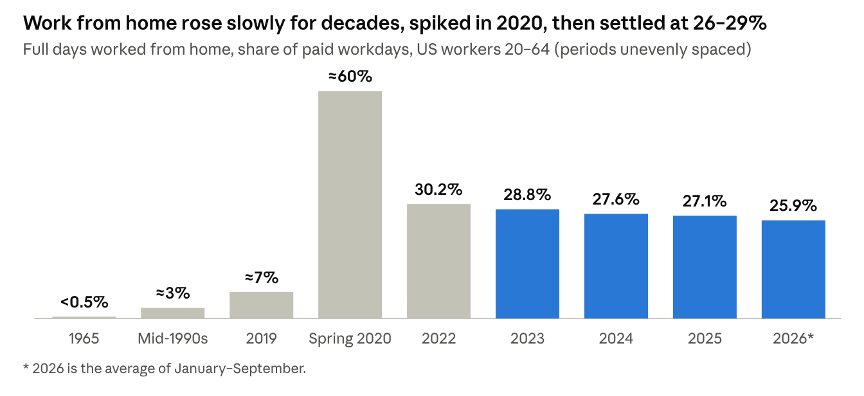
Accordingly, post-pandemic labor force data suggest a permanent shift rather than a return to the office, as presented above. This is a significant increase when compared to only about 5–7% of paid workdays occurring at home in 2019.3
Remote work is also uneven across jobs. Dingel and Neiman estimate that only about 37 percent of US jobs can be done entirely from home; the rest require being on site.4 That unevenness is what makes the question interesting for worklife: a shift this large, concentrated in some occupations, could change how long people in those occupations keep working.
What Worklife Tables Measure
Worklife tables are constructed by analyzing people’s employment status and decisions over time, noting who continues in the labor force, who exits, and who rejoins. By linking these annual transitions together using survival probabilities from life tables, one can estimate the expected number of years an individual of a given description is likely to spend in the workforce. These worklife tables are constructed in this manner and involve such factors as age, sex, education, and initial participation status in the labor force.1
What they do not condition on is the work itself: how physically demanding it is, how flexible it is, or whether it can be done from home. That matters because the ability to remote work could change a person’s working life by making it easier to stay in a job or to come back to one.
Worklife Tables Accounting Disability
Disability is the one area where practitioners have tried to adjust worklife for something beyond the standard characteristics, and it has been contested for decades. Tables that present worklives of people with disabilities have been criticized for the survey questions used to identify disability, for the method used to compute them, and for treating very different conditions as one.5
More recent research adds a further problem. Many people who report a disability in one survey no longer report one a year later, about 40 percent in the Current Population Survey. Treating a reported disability as permanent therefore overstates its effect on a working life.6
Remote Work and Disability Employment
The clearest evidence linking remote work to staying in the workforce concerns people with disabilities. Their employment has long been far below everyone else’s: across OECD countries the gap averages about 27 percentage points.7 After the pandemic, that began to change.
Bloom et al. (2026) document a sharp rise in US disability employment after 2020, over the same years that remote work roughly quadrupled.7 According to official figures, the employment rate of people with a disability increased in the post-pandemic period by about 18 percent above its 2019 level, while the rate for workers without a disability returned to its pre-pandemic level and stayed there.8 No other major group, by gender, race, age, or education, saw a comparable increase.
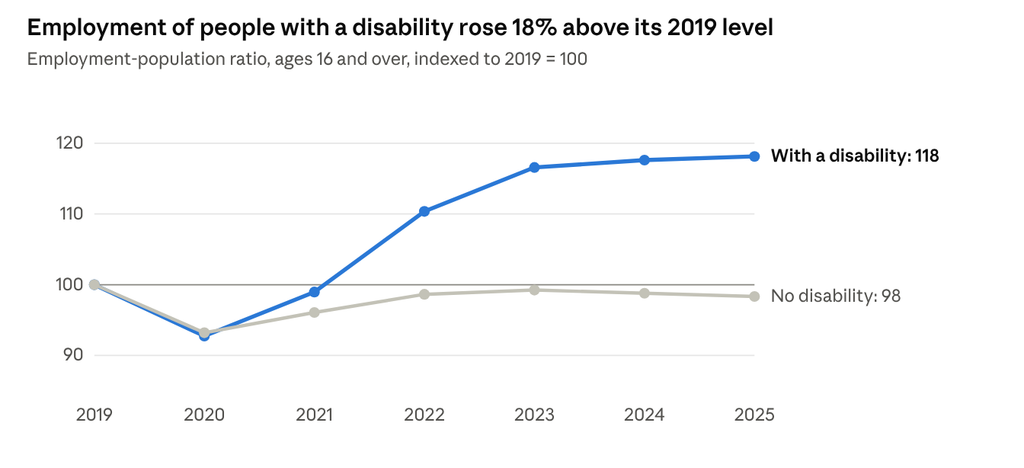
The rise was concentrated in occupations where remote work grew most. Bloom et al. (2026) compared occupations by how much working from home grew in each. Where the share of workdays done from home rose by 10 percentage points (say, from 10 to 20 percent), full-time employment of people with physical disabilities grew about 10 percent more than in occupations where remote work stayed flat. On that basis, the growth of remote work accounts for roughly 68 to 85 percent of disabled workers’ post-pandemic gain in full-time employment.7
Correlation or Causation?
Workers whose jobs can be performed from home tend to stay in the workforce longer. Sanzenbacher finds that older remote workers without disability who work remotely are 1.4 percentage points less likely to retire within a year relative to an otherwise similar counterpart.9 Liu and Quinby find that remote work raised employment among older disabled people by about 10 percent between 2018 and 2022, partly by helping them to return to work or switch careers instead of quitting.10
The harder question is whether remote work causes these differences or merely comes bundled with them: jobs which can be performed from home are better paying, less physically demanding, and held by more educated workers on average.11 People in those sorts of jobs might work longer years in any case, and people seeking a long career, or have the health to sustain one, might seek out remote-friendly jobs in the first place, a possibility Sanzenbacher raises.
The pandemic helps untangle the two: it expanded remote work suddenly, for reasons unrelated to any individual worker’s plans or health, and far more for some occupations than for others. That is a natural experiment: Bloom, Dahl and Rooth use it by comparing occupations where remote work increased significantly with those where it increased slightly, taking into account who holds those jobs and how tight the labor market was.7
In Practice
For experts estimating lost earning capacity, three points follow.
The pre-injury occupation may matter. Standard tables treat all occupations alike. Where the evidence links remote-capable work to longer careers, an expert may reasonably consider whether a claimant’s occupation could be done from home, while recognizing that the published tables do not adjust for it.
Remote work capability is a factor in residual earning capacity. After an injury, the question is what work remains available to the claimant. Courts typically expect injured workers to seek suitable employment, and a sedentary, flexible position may be available where a physically demanding one is not.12 Occupations that can be performed from home increase that set, especially for people with physical capability, and vocational experts are in the best position to identify which are realistically available.
Averages are not individual predictions. Research findings describe groups. A documented history of remote work, a specific employer’s policy, and the nature of the injury all matter more for one claimant than any average. And because survey-reported disability is often temporary, figures built on it should not be read as the outlook for a person with a lasting injury.6
Conclusion
Remote work is no longer a pandemic curiosity. It settled at roughly a quarter of workdays and has stayed there, and its availability differs widely across occupations. The research increasingly reflects that this flexibility keeps some people working who would otherwise have left the workforce, most demonstrably for people with physical disabilities.
The challenge for forensic economists is to bring this phenomenon into worklife estimates. Our team is currently working on bridging this gap, and we plan on presenting our results in the Southern Economic Association (SEA)’s 96th Annual Meeting in Houston, TX this November 21-23, 2026.
Main Author: Timur Hulagu, PhD
- Skoog, G. R., Ciecka, J. E., & Krueger, K. V. (2019). The Markov Model of Labor Force Activity 2012–17: Extended Tables of Central Tendency, Shape, Percentile Points, and Bootstrap Standard Errors. Journal of Forensic Economics, 28(1–2), 15–108.
- Barrero, J. M., Bloom, N., & Davis, S. J. (2023). The Evolution of Work from Home. Journal of Economic Perspectives, 37(4), 3–24.
- Aksoy, C. G., Barrero, J. M., Bloom, N., Davis, S. J., Dolls, M., & Zarate, P. (2025). The Global Persistence of Work from Home. Proceedings of the National Academy of Sciences.
- Dingel, J. I., & Neiman, B. (2020). How Many Jobs Can Be Done at Home? Journal of Public Economics, 189, 104235.
- Ciecka, J. E., Rodgers, J. D., & Skoog, G. R. (2002). Journal of Legal Economics, 12(2); Ireland, T. R. (2009). Journal of Legal Economics, 15(2).
- Krueger, K. V., & Skoog, G. R. (2015). Transitions Into and Out of Census Disability. Journal of Forensic Economics, 26(1), 17–51.
- Bloom, N., Dahl, G. B., & Rooth, D.-O. (2026). Work from Home and Disability Employment. American Economic Review: Insights.
- U.S. Bureau of Labor Statistics. People with a Disability: Labor Force Characteristics, annual news releases for 2020–2025 (2025 release).
- Sanzenbacher, G. T. (2025). Has Remote Work Extended Workers’ Careers? Center for Retirement Research at Boston College, Issue Brief 25-9.
- Liu, S., & Quinby, L. D. (2024). Has Remote Work Improved Employment Outcomes for Older People with Disabilities? Center for Retirement Research at Boston College, Working Paper 2024-12.
- Mongey, S., Pilossoph, L., & Weinberg, A. (2020). Which Workers Bear the Burden of Social Distancing Policies? NBER Working Paper 27085.
- Ireland, T. R., & Slesnick, F. (2021). Gamboa-Gibson Worklife Expectancy Methods and Tables: A Summary of Criticisms Since 2009. Journal of Legal Economics, 27(2).