
What do 65K customer reviews say about the commercial success in the plant-based meat industry?
May 30, 2024
Introduction
In civil litigation, some cases require valuation of a business due to splitting assets between owners, or estimating how much an interruption in business operations cost its owners, due to claims such as breach of contract, personal injury etc. In particular, business valuation poses unique challenges for experts, especially when the business itself is not a large corporation where the value of the business is no longer heavily dependent on its owners.
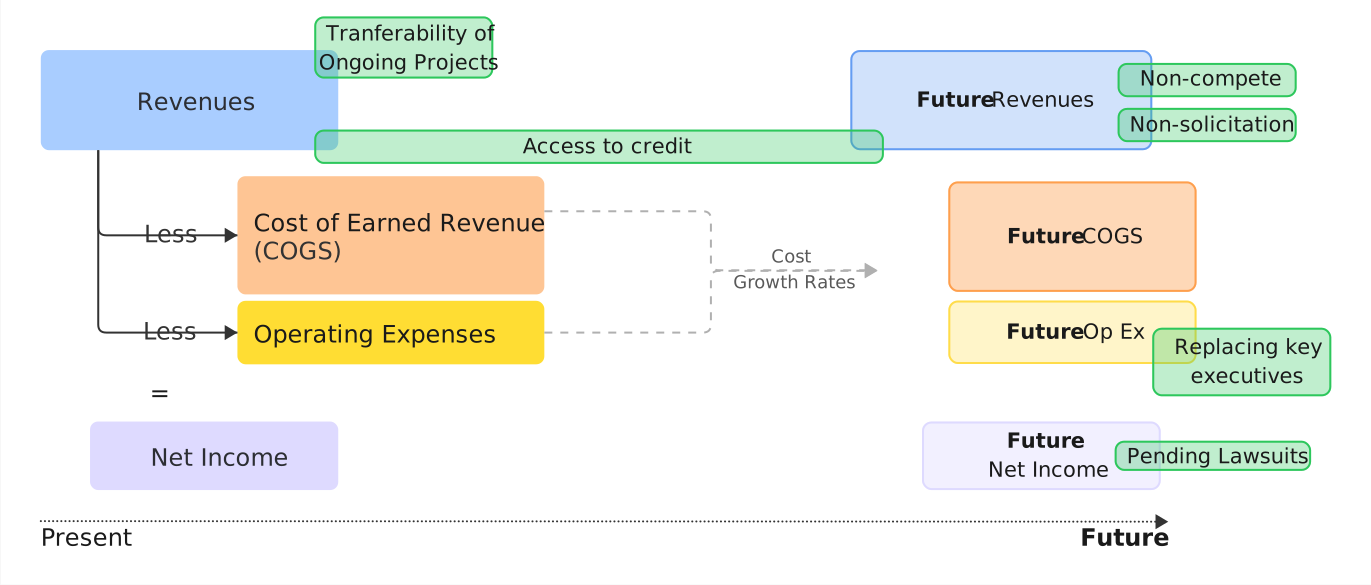
Experts are usually asked to estimate the value of a business as of a specific date, or before a certain interruption took place. When doing so, experts will consider all of the factors that a real buyer would have considered when buying that business: put another way, any factor that could affect the long-term value of a business will and should be part of expert’s consideration. One of these factors, maybe the most important one, is how well the intangible assets of the business in question are protected. When applying this framework to small businesses, this would typically reflect itself in terms of whether the owners would be bound by a non-compete or not, i.e. restricting who will “keep the customers” and “who is allowed to compete for customers”, which will jointly determine to what extent the business’s future value is protected.
Non-Compete Agreements
In these instances, the most common concern is potential competition from the prior owners or key executives post-sale. 1 While every business has competitors, the former ownership of a business poses a much greater risk to the buyer, as they could rely on their personal connections to take back the intangible assets of their former firm by recruiting their former clients and employees. Kini et al. (2021) demonstrate this, finding that higher proportions of intangible assets to total assets at a firm are associated with a higher likelihood of the firm’s CEO signing a non-compete. 2
For this reason, many buyers demand that the previous owners or key employees sign non-compete agreements as part of the business sale, preventing them from competing against the firm post sale by restricting their entry into that industry or a specific geographic area following the sale. Additionally, buyers may ask for a non-solicitation clause to specifically bar the former owners from taking their old clients and employees with them after the sale. These agreements therefore protect the value of the firm’s intangible assets during its transfer to the new ownership, and allow the old ownership to market the firm’s intangible assets as part of the transaction. 3
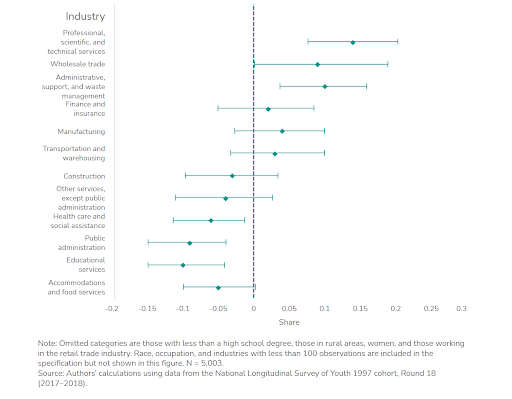
According to the Survey of Household Economics and Decisionmaking (SHED)—a key Federal Reserve survey, from 2022, and found that about one in nine adult workers currently has a non-compete. 4 Expectedly, prevalence of non-competes vary significantly across industries, reflecting the dependency of firms success on intangible assets, as shown by researchers at the Minneapolis FED:5
In litigation, however, experts are often tasked with valuing the business based on a hypothetical sale scenario, or a before / after analysis using statistical techniques built on cash flow models.6 Depending on the facts of the case, owners would not have been willing to agree to a non-compete in a hypothetical sale. If so, they would have remained free to immediately re-enter the market as direct competitors following the transaction. Therefore, a rational hypothetical buyer would demand a lower price for the business to account for the operational risk of losing key staff and client relationships, and therefore revenue, to the former owners. This means that the valuation expert would need to determine the value of the non-compete agreement with the former owners to the hypothetical buyer and adjust the firm’s value down by that amount. 7
Value of Non-Competes
One way of valuing a non-compete is by determining the potential threat from the previous owners / key executives who possess the intangibles that enable them to steer business (i.e. customers) or talent (i.e. employees or contractors) away from the new owner(s), should they decide to compete against their old firm.
To do this, one method, sometimes referred to as the “with-and-without” method, looks at the difference in the firm’s forecasted cash flow, and resulting valuation, under two scenarios: one where the key executives are restricted by a non-compete, and one where they are not. 8 In this first scenario, the value of the firm with the non-compete is based on the cash flow of the firm as-is. However, to value the second scenario, it’s necessary to estimate future cash flow under a new set of assumptions about what the flow of business would be given the competition from the previous owners. 9 The value of the non-compete, then, is the difference between the value from the first scenario and the value from the second. 10
In practice, to understand and quantify the value of a non-compete for a business sale, one needs to take a close look at how competition from the firm’s former owners would threaten the firm’s customer base. The exact degree and types of threats posed by the former owners are unique to each business and industry, but there are some common factors that should be considered in most cases:
Many factors play a role to understand how valuable and necessary the non-compete is for valuing a specific business. One factor is the firm’s size in terms of headcount. In general, in smaller firms, owners perform a larger share of the duties of the firm, whereas in larger firms, there may be individuals or teams performing duties related to client acquisition and management. This means that, all else equal, the former owners and key executives of smaller firms would be expected to more easily capture a higher share of the firm’s customers than owners of larger firms.
Another factor is the size distribution of the firm’s clients, along with what it is selling and who its customers are. While some firms provide goods or services on a frequent basis to hundreds or thousands of customers, such as barbershops and grocery stores, others, such as construction or consulting firms, are hired by a smaller number of clients for a long period, often on a contractual basis. In the latter case, having fewer, larger clients makes the firm more vulnerable to competition from the former owners,
Another is the company’s reputation or brand recognition. Separate from the reputation of the owner, the reputation of the business itself can often be considered an asset of the firm/brand and therefore would be transferred to the new ownership. 11 However, in cases where the identity of the firm is too intertwined with the former owner or owners (a potential example could be a medical practice named after the practicing physician), there may not exist a company reputation distinct from the owners’ reputation. In these cases, customers may still be more loyal to the former owners of a firm, rather than the firm itself.
The nature of the owner or owners’ relationship with the firm’s customers also matter. In cases where the owners had little or no direct contact with the firm’s clients, then their ability to later take those clients with them to a new firm would be mitigated, whereas if they personally knew the firm’s clients and regularly interacted with them as part of business operations, then they would be well positioned to rely on their personal relationships with the firm’s clients to take them from their old firm to their new firm.
In Practice
When using a with-and-without approach, experts must design a reasonable “without non-compete” scenario based on each of the factors, as well as others that may apply in a given case. Here we provide an example to construct such a scenario, which is only applicable to some cases, an expert can split a firm’s historical revenues (and/or profits) by whether they are from new clients or repeat clients:
- First-Time Clients: Revenue streams from clients that had no prior jobs with the firm as of the project start date. This can give an insight into a firm’s institutional capacity, and therefore may illuminate the ability of a hypothetical new owner to generate novel clients based purely on the company’s capabilities, entirely independent of the former owners’ personal relationships.
- Repeat Clients: Revenue streams from clients that had worked with the firm prior to the job in question, would give some insight into the share of business attributable to the owner or owners’ connections. While repeat business is often considered a positive factor when selling a firm, without a non-compete, these clients would be at risk of continuing to do business with the former ownership instead of the firm itself.
Of course, while this approach will not be suitable in many cases, as different firms and industries will have unique factors that may require a different or more complex approach, this is just one strategy available to experts to identify the share of business at risk without a non-compete. Ultimately, experts must use their expertise, analysis, and judgment to determine whether an adjustment for not having a non-compete is appropriate, and how to attempt to value that non-compete.
Conclusion
When a valuation scenario includes a hypothetical sale where the firm’s owners wouldn’t sign non-compete or non-solicitation agreements, the damages expert must estimate the potential revenue that would be lost to the former ownership. As established in both valuation literature and economic theory, the unrestricted freedom of former partners to immediately re-enter the local market fundamentally threatens the transferability of repeat clients and ongoing revenue streams, taking away from the value of the firm to a hypothetical buyer.
By employing the “with-and-without” method, experts can attempt to quantify the value of the non-compete by estimating the loss in future earnings from competition with the former owners. However, when constructing the scenarios for the with-and-without method, experts must take into account aspects of the business such as size, industry, how intertwined the owner’s and firm’s identities are, and how intensely the owner dealt with clients. There are many ways experts can estimate this, such as an approach involving segmenting historical revenue into first-time and repeat jobs.
Main Author: Colby Kennedy
- This is especially true of cases where the owners were active in the firm’s operation or were acting as executives of the firm.
- Kini, Omesh, Ryan Williams, and Sirui Yin. “CEO noncompete agreements, job risk, and compensation.” The Review of Financial Studies 34.10 (2021): 4701-4744.
- In April 2024, the FTC issued a Final Rule intended to ban most non-compete agreements nationwide, arguing they suppressed wages and restricted labor mobility. However, the rule was vacated by a federal district court in August 2024, which ruled that the agency had exceeded its statutory authority. Consequently, while various state-level restrictions remain in effect, the sweeping federal ban is currently unenforceable. Source: https://www.ftc.gov/news-events/news/press-releases/2024/04/ftc-announces-rule-banning-noncompetes
- https://www.minneapolisfed.org/article/2023/new-data-on-non-compete-contracts-and-what-they-mean-for-workers
- https://www.minneapolisfed.org/article/2021/non-compete-contracts-sideline-low-wage-workers
- Weil, R. L., Lentz, D. G., Evans, E. A. (2017). Litigation Services Handbook: The Role of the Financial Expert. United Kingdom: Wiley.
- As discussed above, there is a similar risk posed by key employees of the firm. However, unlike the former owners, key employees are not being paid by the sale of the business, and would need to be separately incentivized to sign a non-compete if they were not already subject to one.
- Reilly, Robert F. “The Valuation and Amortization of Noncompete Covenants.” The Appraisal Journal 58.2 (1990): 211., Trugman, Gary R. Understanding business valuation, Fourth Edition, p. 805
- Trugman, Gary R. Understanding business valuation, Fourth Edition, p. 805
- Another consideration is the probability that the former ownership would actually compete against the new owner in their market. In valuations for litigation purposes, the timing of the sale could be during a period where the ownership had no intention of retiring, and may have continued practicing in the real world long after the hypothetical sale date. In these cases, it can be argued that the owners would have had a near 100% chance of competing with their former firm post-sale. However, in cases where there is no clear answer to whether the owner or owners would have competed, experts should determine what likelihood a rational buyer would have assumed and apply this percentage to the potential loss from competition to get the expected value of the non-compete.
- https://www.okbar.org/barjournal/jan-2026/business-valuation-in-divorce-litigation/#:~:text=In%20divorce%20litigation%2C%20valuing%20the,is%20a%20privately%20owned%20business.
