
The American Time Use Survey (ATUS) in Litigation: Eldercare — Frequency, Duration, and Recipients
November 12, 2026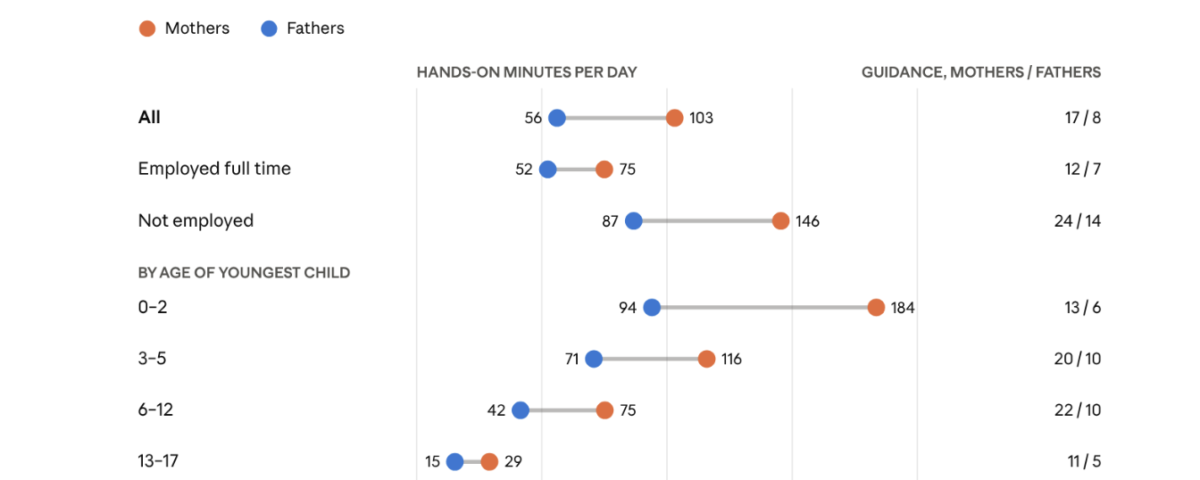
When a parent is injured or dies, the children lose more than income. They lose the parent’s daily care: feeding, bathing, driving, and watching over them. They also lose the parent’s guidance: the talks, the reading, the help with homework. Courts often treat these as separate elements of damages, and the loss changes every year as the children grow.
The American Time Use Survey (ATUS) can measure both. This post uses our pooled 2003–2025 ATUS microdata, with 2020 left out. It covers 84,491 parents age 18 and older who had at least one of their own children under 18 at home: 49,387 mothers and 35,104 fathers. We look at how much time parents spend, how it changes with the youngest child’s age, how much of it is guidance, how often it happens, and how it has changed since 2003.
ATUS Measured Metrics
ATUS records childcare in two ways.
- Hands-on childcare is time when caring for a child is the main activity, such as feeding a baby, reading a story, or driving to practice.
- Watching over is time when a child under 13 is in the parent’s care while the parent does something else, such as cooking or watching television. ATUS asks about this separately, and it does not overlap with hands-on time.
We sort hands-on childcare into categories. Each minute is coded to one activity, so the categories can be added.
| Category | ATUS codes | Examples |
|---|---|---|
| Physical care | 030101 | Feeding, bathing, dressing |
| Play and activities | 030103–030105, 030110 | Playing, sports, arts and crafts, attending events |
| Talking with and listening to | 030186 (incl. 030106, 030107) | Conversation, advice, discussion |
| Reading | 030102 | Reading to or with the child |
| Education | 0302xx | Homework, school meetings, home schooling |
| Planning | 030108 | Organizing and planning for the child |
| Health | 0303xx | Medical care, doctor visits |
| Transport and waiting | 030111, 030112, 180301–180303 | Driving, pick-up and drop-off, waiting |
| Looking after | 030109 | Watching the child as the main activity |
Care by the Youngest Child’s Age
Hands-on care is heaviest when children are babies and falls steadily as they grow. Parents whose youngest child is under 1 spend about 170 minutes a day on it, almost 3 hours. That falls to about 86 minutes when the youngest is 5, about 38 at 12, and about 14 at 17. Over a year, that is about 870 hours for parents whose youngest is under 3, and about 140 hours for parents whose youngest is a teenager.
The mix changes too. Physical care and play fill most of the early years. Guidance grows through the school years and makes up a larger share of a smaller total for teenagers.1
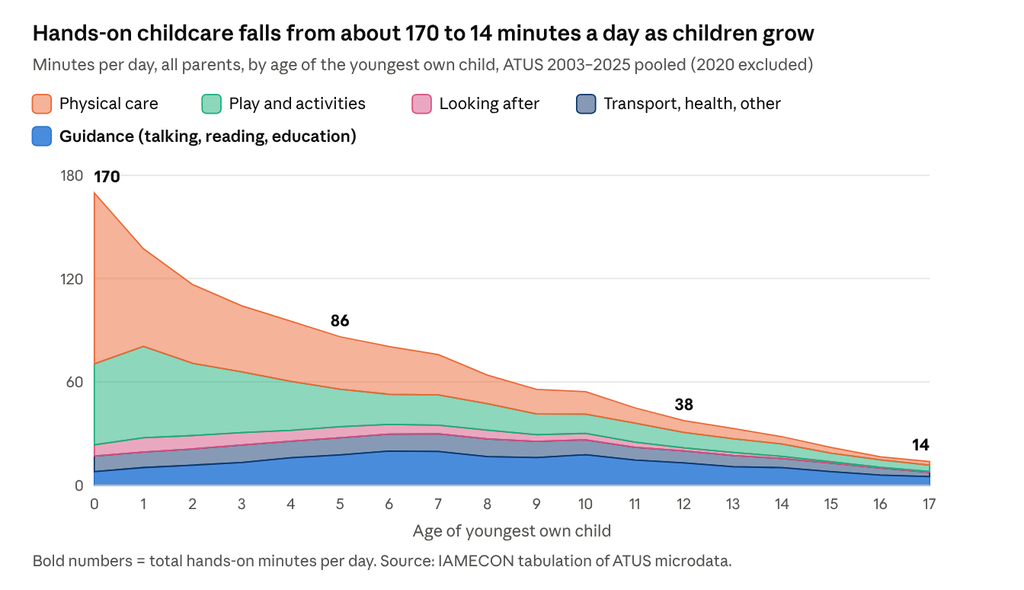
Figure A · Hands-on childcare by age of the youngest child, all parents
This age shape is what an analyst can use to project a loss year by year: the estimate can follow the rows for the youngest child’s age as the children grow toward 18.
Watching over is much larger. Parents whose youngest child is under 13 have a child in their care, while doing something else, for about 5.5 to 6 hours a day. ATUS asks about watching over only for children under 13, so the measure drops to near zero once the youngest child turns 13.
Guidance: Advice, Counsel, and Teaching
ATUS has no code called “guidance.” The most related code is talking with and listening to children (030186). A broader measure adds reading (030102) and the education codes (0302xx). These codes do not overlap, so they can be added. Organizing and planning for children (030108) can potentially be considered as related, depending on what is being measured for what purpose, but it is more about managing the child’s life than teaching, and it averages under 1 minute a day.
Guidance is a small part of hands-on care. Across all parents it averages about 13 minutes a day, or about 78 hours a year. Mothers average about 17 minutes and fathers about 8. That is about 16% of hands-on childcare time. But the share grows with age, from about 7% for parents of children under 3 to about 35% for parents of teenagers. Very importantly, again these are averages across those who provide such activities and those who recorded none. Considering the participant averages could be more relevant if the goal is to measure duration conditional on attendance.
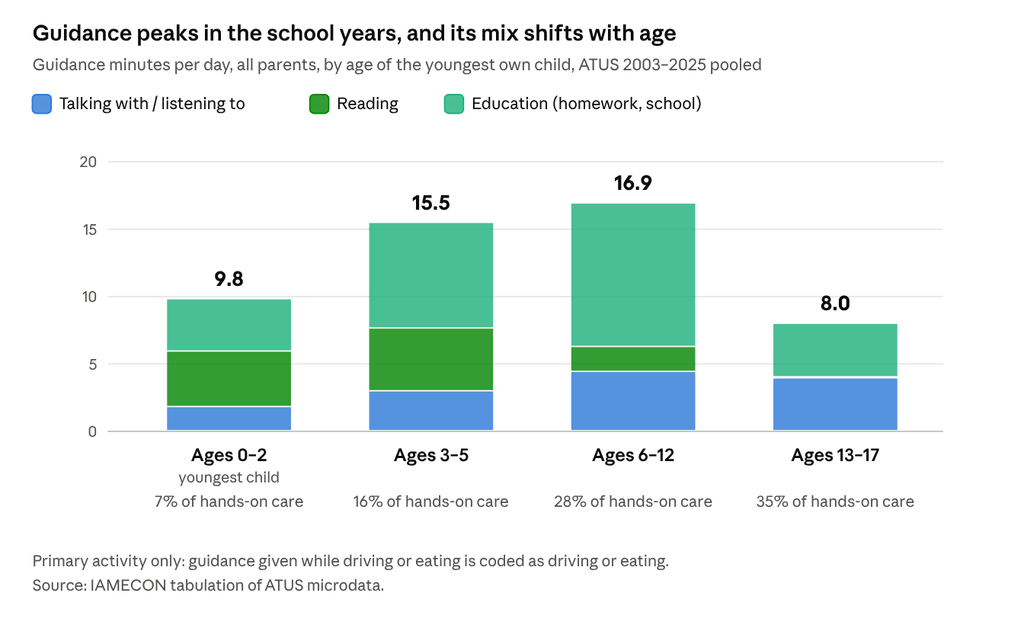
Figure B · Guidance by age of the youngest child, all parents
Each part of guidance follows its own path. Reading peaks before school, at about 5 minutes a day, and nearly disappears for teenagers. Help with homework and school peaks at ages 6 to 12, at about 11 minutes. Talking and listening rises through the school years and holds at about 4 minutes into the teens.
Talking alone, the narrowest measure of advice and counsel, averages about 3 minutes a day. On a given day only about 9% of parents report it, and those who do spend about 36 minutes.
One caution matters more here than anywhere else. ATUS counts guidance only when it is the main activity. Advice given in the car is coded as travel, and a talk over dinner is coded as eating. So these figures understate the time parents spend guiding their children. They are best seen as a floor.
Mothers and Fathers, by Work Status
Mothers average about 103 minutes of hands-on care a day and fathers about 56. The gap is widest when the youngest child is a baby, at about 184 minutes for mothers and 94 for fathers. Work status matters about as much as sex. Mothers who are not employed average about 146 minutes, against about 75 for mothers who work full time. Fathers who are not employed average about 87 minutes, against about 52 for fathers who work full time.
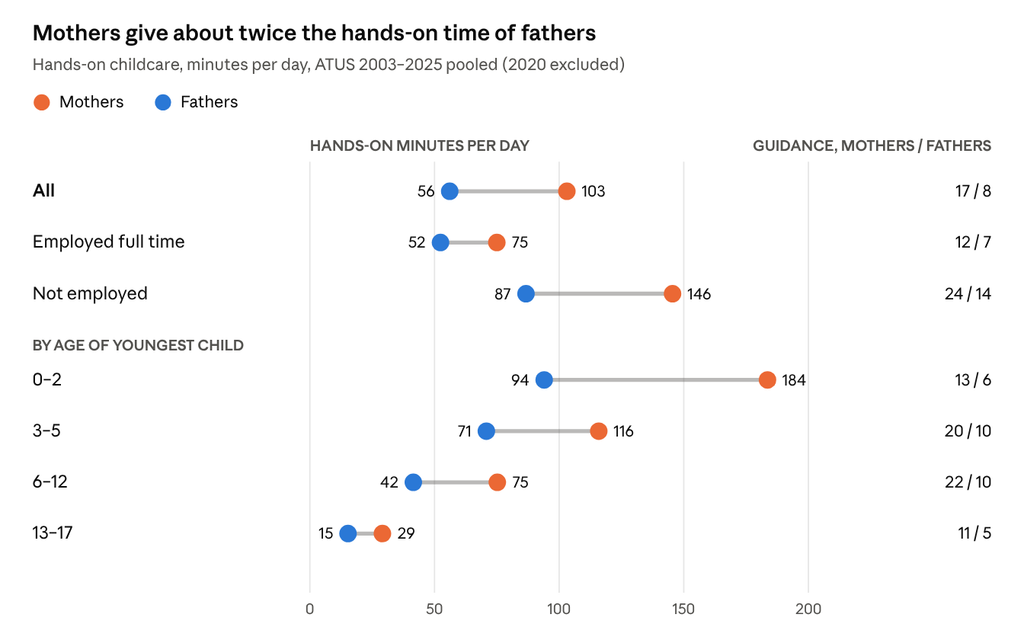
Figure C · Hands-on childcare and guidance, mothers and fathers
Guidance follows the same pattern. Mothers average about twice the guidance time of fathers in every group. Mothers who are not employed give about 24 minutes a day, and fathers who work full time about 7. Single mothers average about 84 minutes of hands-on care and 14 minutes of guidance, between the figures for mothers who work full time and for all mothers.
These gaps are why matching the right group matters. A full-time working father and a mother at home with a toddler can differ by a factor of three or more.2
Diary Based Frequencies
For young children, hands-on care is close to a daily event. Guidance is not. The chart shows the share of parents who recorded any time on their diary day, in other words, the following can only partially be interpreted as individual frequencies, but rather it reflects cross sectional averages across daily respondent-diaries.3
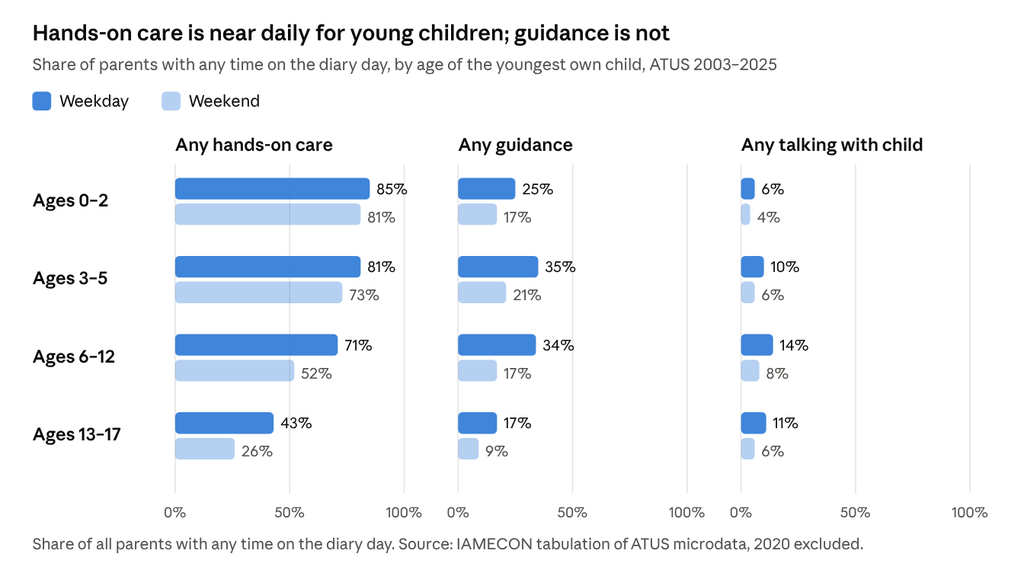
Figure D · Share of parents with any time on the diary day
Following this definition of frequency, guidance happens on about one weekday in three for parents of school-age children, and about half as often on weekends, when there is less homework. Talking with children as a main activity shows up on 4% to 14% of days.
Surveys can serve as a check, but they measure something different. Pew found that 50% of parents with children under 12 say they read to their child every day, and another 26% a few times a week (Pew Research Center, 2013). In ATUS, reading as the main activity shows up on about 14% to 16% of diary days for parents whose youngest child is under 6. A survey answer describes a habit and may count a few minutes at bedtime. The diary records reading only when the parent reports it as what they were doing. Both are useful, and case testimony about frequency can be weighed against each.
Watching Over, and the Overlap with Household Services
Watching over is the largest childcare measure by far. For parents whose youngest child is under 13, it averages about 5.5 to 6 hours a day, several times their hands-on time. Researchers have long argued that counting only hands-on time understates what parents devote to children, because supervision is real work even when the parent is doing something else (Folbre et al., 2005).
But watching-over time happens during other activities. About a third of it falls while the parent is relaxing or socializing, about a quarter during household work, and about an eighth during meals.
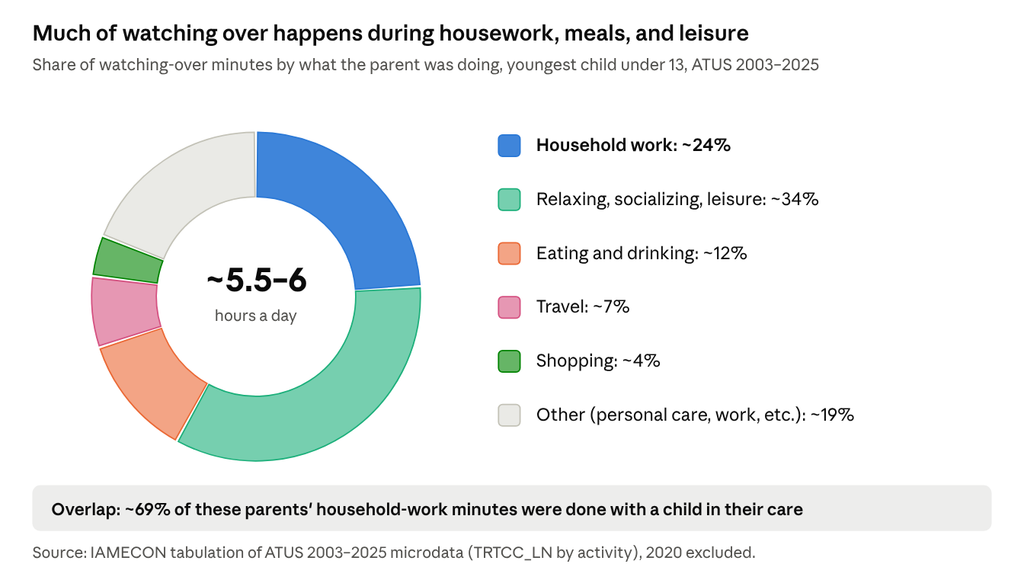
Figure E · Where watching-over time falls, parents whose youngest child is under 13
This matters for a damages estimate in two ways, where the expert needs to be clear on what they are presenting and the trier of fact will draw the final line.
- Double counting. About 69% of these parents’ household-work minutes were done with a child in their care. Adding watching-over time on top of a household services estimate would count much of the same time twice. This is the same overlap we found for eldercare in Part III.
- What is being replaced. Watching over is supervision, not a task. Whether and how to value it, for example only for the hours a paid caregiver would be needed, is a judgment that depends on the children’s ages and the facts of the case.
Changes from 2003 to 2025
Mothers’ hands-on time has held steady, at about 101 minutes a day in 2003–2005 and about 102 in 2023–2025. Fathers’ time rose by about a quarter, from about 50 minutes to about 63. The rise came even though children got slightly older on average, which by itself would pull the averages down.
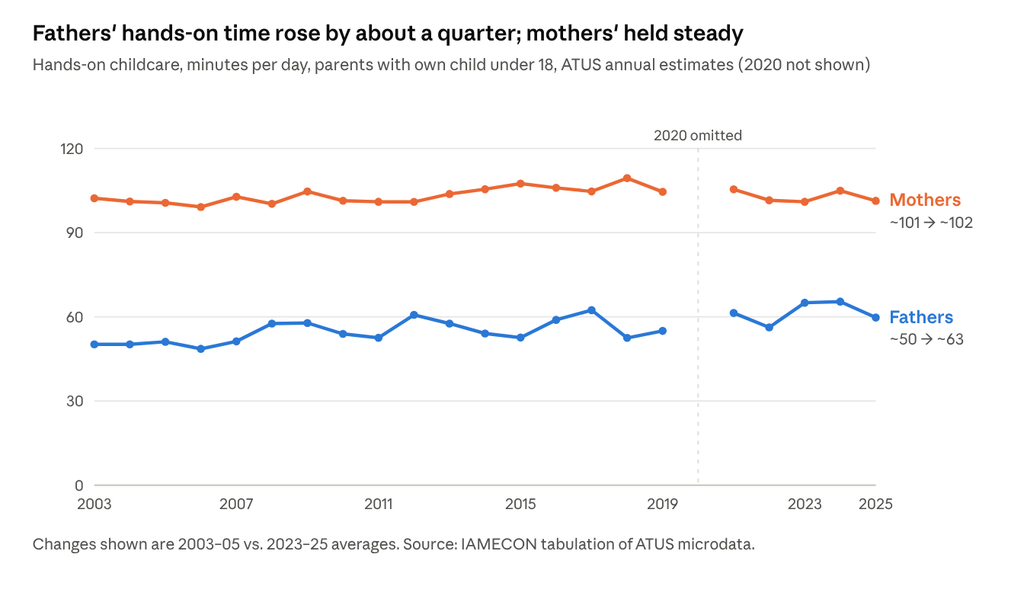
Figure F · Hands-on childcare, mothers and fathers, 2003–2025
Guidance shows no clear trend. Fathers have averaged about 7 to 9 minutes a day across the period, and mothers mostly about 15 to 19, with year-to-year noise. Watching over has also stayed in a fairly narrow range.
Earlier research found that parents’ childcare time rose sharply starting in the mid-1990s, especially among college-educated parents (Ramey & Ramey, 2010), and that more-educated parents spend more time with their children (Guryan et al., 2008). Our data show that the higher level has held for mothers and kept rising for fathers. For an estimate, this makes the choice of years matter most for fathers. Recent years describe today’s fathers better, while pooling all years adds precision for narrow groups.
Letting the Facts of the Case Guide the Choices
As with household services and eldercare, there is no single correct way to build a childcare or guidance estimate from ATUS. The main choices are best made in light of the evidence:
- Care, guidance, or both. Courts often treat lost care and lost guidance as separate elements. ATUS can measure each, and the codes do not overlap.
- Hands-on time only, or watching over as well. Watching over is large, but it overlaps with household work and leisure, and it measures supervision rather than tasks.
- Age profile. The loss changes sharply as children grow. Following the rows for the youngest child’s age year by year is one way to reflect that.
- Characteristics to match. Gender and work status matter as much as anything, and the spouse’s work status can matter too.
- One parent or both. After a death, the surviving parent may take on some of the care. How to reflect that depends on the household.
Each of these is a judgment the analyst should be able to explain and support with the record. Because each respondent reports a single day, ATUS describes groups well but not any one family (Frazis & Stewart, 2012). ATUS provides the national benchmark; the facts determine how it applies.
Closing the Series
This is the last post in our series. Across four posts, we have looked at how ATUS measures household services, eldercare, childcare, and parental guidance, and why the same minute can show up in more than one place. In each area, ATUS provides the national benchmark, and the facts of the case decide which categories, groups, and years apply.
IAMECON builds childcare, guidance, eldercare, and household services estimates from the full ATUS microdata, matched to the facts of each case. If you have a matter involving lost care or guidance, contact us to discuss how the data may apply.
Main Author: Devrim Ikizler, PhD
References
- DeSilver, D. (2013). Half of parents with young children read to them every day. Pew Research Center.
- Folbre, N., Yoon, J., Finnoff, K., & Fuligni, A. S. (2005). By What Measure? Family Time Devoted to Children in the United States. Demography, 42(2), 373–390.
- Frazis, H., & Stewart, J. (2012). How to Think About Time-Use Data. Annals of Economics and Statistics, 105/106, 231–245.
- Guryan, J., Hurst, E., & Kearney, M. (2008). Parental Education and Parental Time with Children. Journal of Economic Perspectives, 22(3), 23–46.
- Ramey, G., & Ramey, V. A. (2010). The Rug Rat Race. Brookings Papers on Economic Activity, 41(1), 129–199.
Data: IAMECON tabulations of ATUS 2003–2025 multi-year microdata (respondent, roster, and activity files), 2020 excluded, weighted with ATUS final weights. Parents are respondents age 18 and older with at least one own child under 18 in the household.
- In this post, talking with and listening to children, reading, and education are grouped as “guidance” for illustrative purposes only. In a forensic matter, which ATUS categories count as guidance, or as care, is a decision for the expert, based on the facts of the case and the applicable law.
- ATUS also records care for children who do not live with the respondent, such as a child living with a former spouse. For purposes of brevity, we excluded such cases from this analysis.
- Because most diary days show no guidance at all, the average for everyone in a group, zeros included, is the natural summary. From that perspective, it reflects how often guidance happens. The average for parents who did it on the diary day, about 50 minutes, describes a guidance day, not a typical day.