
Socio Economic Impact Analysis
Our team specializes in conducting rigorous Economic and Social Impact Studies designed to quantify the multifaceted effects of organizations, specific projects, and legislative changes on regional and national ecosystems. By providing clear, data-driven insights, we help stakeholders, policymakers, and non-profits demonstrate their total footprint and justify strategic investments through a lens that captures both financial and societal value.
A cornerstone of our analytical framework is the use of state-of-the-art methodologies, including IMPLAN and RIMS II multipliers provided by the U.S. Bureau of Economic Analysis (BEA.gov). This industry-standard methodologies allows us to capture the "multiplier effect"—measuring how an initial injection of spending ripples through the economy to generate additional output, earnings, and employment. Our impact models go beyond simple arithmetic, incorporating:
- Integrated Social Impact Analysis: We evaluate broader societal contributions, assessing how projects influence community well-being and regional development.
- Stakeholder & Consumer Sentiment: We conduct and analyze comprehensive surveys of visitors, consumers, and local businesses to capture the qualitative drivers of economic activity.
- Tourism & Brand Reputation: Our studies quantify the effects on the tourism industry and the brand reputation of the city or establishment, measuring the value of "destination appeal" and intangible institutional goodwill.
- Direct, Indirect, & Induced Modeling: We provide a granular breakdown of immediate economic activity, secondary supply chain effects, and the gains created when employees spend their earnings within the local community.
By adjoining proprietary financial data, primary survey research, and BEA-derived regional multipliers, we deliver reputable reports that articulate the total value-added contribution of an entity to its broader economic and social landscape.
Argonne National Laboratory Economic Impact Study
(Client: The U.S. Department of Defense)
We conducted a comprehensive economic impact study for Argonne National Laboratory to quantify its scientific, technological, and financial contributions to the state, regional, and national economies. Utilizing industry-standard IMPLAN modeling, we analyzed over $1 billion in annual laboratory spending to measure direct, indirect, and induced effects on employment and output. Our analysis extended beyond budgetary activities to include the market valuation of Argonne’s Advanced Photon Source (APS) facility, the broader commercial reach of its 589 patents, and the regional economic gains generated by thousands of annual facility visitors. By synthesizing massive data sets on scholarly collaborations, startup incubation through Chain Reaction Innovations (CRI), and national alumni presence, we delivered a rigorous assessment of how the laboratory’s multidisciplinary research drives U.S. prosperity.
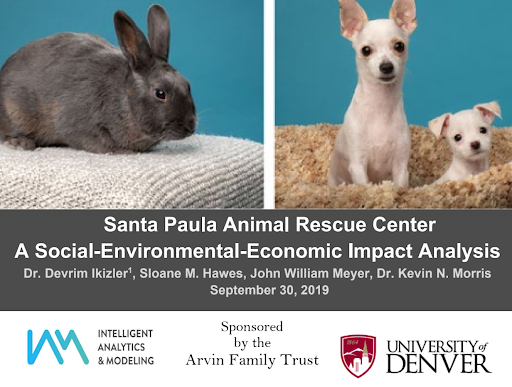
SPARC Social-Environmental-Economic Impact Analysis
(Client: Arvin Family Trust In partnership with Denver University)
We conducted a multi-disciplinary Social-Environmental-Economic (SEE) impact analysis for the Santa Paula Animal Rescue Center (SPARC) to quantify its total contribution to the regional ecosystem. Our methodology integrated industry-standard IMPLAN input-output modeling with an Analysis by Parts approach to isolate the specific economic footprint of shelter operations and planned facility construction. To capture the full spectrum of value, we synthesized a massive, multi-faceted database comprising thousands of social media reviews across multiple platforms—analyzed via Natural Language Processing (NLP) for sentiment scoring—alongside extensive community surveys managed through the REDCap secure data system. Our analysis extended beyond financial metrics to evaluate the lab's role in fostering a "Humane Community," utilizing academic literature to assess impacts on human health, community cohesion, and regional brand equity. By reconciling large-scale qualitative feedback with quantitative regional multipliers, we delivered a rigorous assessment of the shelter's total value-added contribution to the city and county.

Economic Impact Studies of Zoos
(Client: Canopy Strategic Partners)
In partnership with Canopy Strategic Partners, our team has executed six comprehensive economic impact studies for major zoological institutions across the country, providing a data-driven defense of their regional value. Utilizing RIMS II multipliers from the U.S. Bureau of Economic Analysis, our methodology captures the direct, indirect, and induced effects of institutional operations, capital development, and tourism. For these projects, we analyze multi-year datasets covering both historical performance and decade-long projections to quantify total economic output, household earnings, and job support. Our models incorporate nuanced variables such as "leakage" adjustments for non-local vendor spending and differentiated spending patterns for day versus overnight visitors. By synthesizing internal financial records with broader industry benchmarks, we deliver rigorous evidence of how these cultural assets act as consistent fiscal contributors and vital learning destinations within their regional scientific ecosystems.
Andy Hill CARE Fund Economic Impact Study
(Client: Andy Hill CARE Fund)
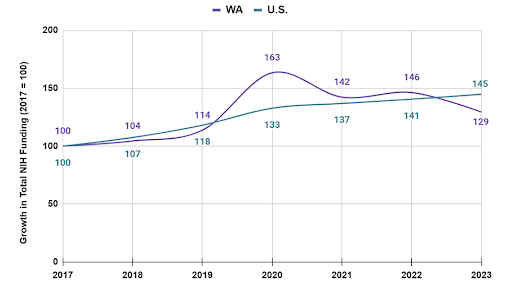
We provided a comprehensive economic impact study for the Andy Hill Cancer Research Endowment (CARE) Fund to quantify its role as a catalyst for cancer research and economic growth in Washington State. Utilizing RIMS II multipliers from the U.S. Bureau of Economic Analysis, our team calculated that the Fund's grants generated a total economic impact of $113.5 million between FY2018 and FY2023. This methodology captured the "ripple effect" of grant spending, demonstrating that every dollar awarded by the CARE Fund generates 1.95 dollars for the state economy and supports a total of 459 local jobs. Our analysis extended beyond simple multipliers to evaluate the Fund's strategic position within the broader life sciences sector, analyzing its influence alongside federal, nonprofit, and private funding sources. By synthesizing data on peer-reviewed publications, matching fund ratios, and the specific growth of biotechnology and medical laboratory sub-sectors in Washington, we delivered a rigorous assessment of how public-private partnerships maximize the impact of state investments in transformational health research.
Austin No-Kill Resolution Impact Study
(Client: Watershed Animal Foundation in partnership with Denver University)
We conducted an interdisciplinary social-environmental-economic impact analysis of the City of Austin’s "No Kill" resolution to evaluate its effects on municipal governance, public health, and regional prosperity. Our methodology utilized a One Health framework and Input-Output (I-O) modeling via IMPLAN Analysis-by-Parts, which allowed for a nuanced isolation of direct, indirect, and induced economic effects. To ensure a comprehensive valuation, our team synthesized a massive, multi-source database that integrated longitudinal animal shelter intake and outcome data, public health bite case records, and city-wide animal cruelty reporting. Furthermore, we employed time-series event methods and linear regression analysis to evaluate shifts in community engagement, including large-scale survey data and Google search trends to quantify the policy’s impact on city brand equity and workforce migration.