
Research Grants
We are dedicated to extending the frontiers of economic research by addressing contemporaneous societal and market challenges through our curiosity and forensic expertise in the field. Our team operates at the intersection of academic theory and practical application, frequently securing federal and private research grants—including over $1.5 million in funding from the National Science Foundation (NSF) and the Small Business Administration (SBA)—to conduct high-stakes modeling on issues ranging from urban spatial mismatch to banking industry consolidation. By maintaining a robust R&D pipeline, we ensure our clients benefit from the latest advancements in econometric and computational techniques.
Advancing the Literature in Forensic Economics
Our forensic research program is designed not just to apply established methods, but to contribute novel methodologies to the peer-reviewed literature. We are currently leading a transformational project (funded by an NSF Phase I grant), to automate the economic loss estimation process used in civil litigation. This innovation aims to standardize complex forensic procedures into deterministic algorithms, increasing transparency and judicial efficiency.
- Forensic Methodology Development: We are pioneering the automation of back-pay, front-pay, and business interruption calculations, bridging the gap between static academic assumptions and dynamic, data-driven modeling. (Gaughan, P. A. (2020). Measuring Business Interruption Losses and Other Commercial Damages. John Wiley & Sons.)
- Economic Innovation & Market Evolution: Our team analyzes how disruptive technologies and regulatory shifts reshape industries, utilizing sophisticated simulations to forecast long-run equilibrium. (Schumpeter, J. A. (1942). Capitalism, Socialism and Democracy. Harper & Brothers.)
- Rigorous Empirical Standards Every project is grounded in academically sound methods, utilizing large-scale datasets from the BLS, Census Bureau, and FDIC to provide unbiased estimations. (Kuhn, T. S. (1962). The Structure of Scientific Revolutions. University of Chicago Press.)
Our commitment to the scientific method ensuring that our expert reports withstand the highest levels of scrutiny from both the court and the scientific community.
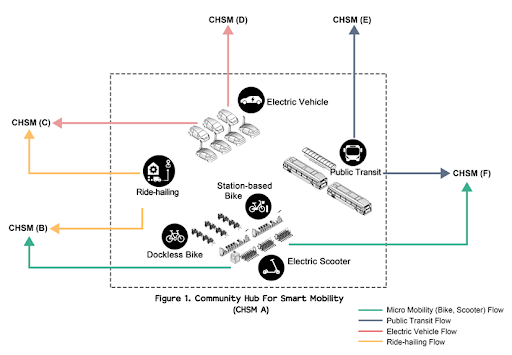
Community Hub for Smart Mobility: NSF CIVIC Innovation Award with City of Austin and UT Austin
(Grantor: National Science Foundation)
As part of the CIVIC Innovation Challenge (a collaboration between the NSF, DOE, and DHS), our team at Intelligent Analytics and Modeling (IAMECON), in partnership with The University of Texas at Austin and the City of Austin, was awarded a $1 million Stage 2 grant (NSF Award #2133302) to address the "spatial mismatch" between affordable housing and employment. This project centers on the co-creation of a Community Hub for Smart Mobility (CHSM) in the historically under-resourced Georgian Acres neighborhood in northeast Austin. The hub serves as a community-level point of access for multiple transit modes—including shared e-bikes, e-scooters, ride-hailing, and electric vehicle charging stations—integrated with existing public transit.
Our work on this initiative involves a multi-stage research and implementation framework:
- Quantitative Modeling: Utilizing GIS analysis, transportation modeling, and machine learning to evaluate the efficiency and impact of the hub on resident mobility.
- Qualitative Community Engagement: Leading co-design and co-development efforts through surveys, interviews, and focus groups with local residents and civic partners.
- Economic Impact Evaluation: Assessing how improved access to transportation can mitigate the economic losses associated with traffic congestion and the job-housing mismatch, which is estimated to cause a $29 billion annual loss to the U.S. economy.
- Scalability & Transferability: Developing the CHSM as a transferable model for vulnerable neighborhoods nationwide, with scaling support provided through the City of Austin's Project Connect.
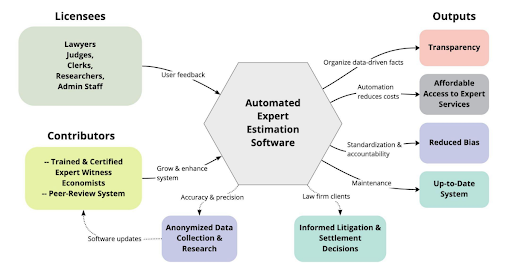
Automated Forensic Economist
(Grantor: National Science Foundation)
Awarded a $275,000 Phase I grant from the National Science Foundation (NSF Award #2304596), this project aims to revolutionize the legal industry by creating a "TurboTax for litigation". The innovation addresses the high costs, subjectivity, and lack of uniformity in traditional forensic economic estimations, which currently require manual work from experts costing tens of thousands of dollars . Focused initially on employment and personal injury cases, the software provides a fast, fast, inexpensive, and objective system for computing financial losses, such as back-pay and front-pay, to help parties make more informed settlement and litigation decisions.
The technical solution centers on a Python-based backend that harmonizes and aggregates massive, disparate public and private datasets, including Bureau of Labor Statistics (BLS) wage profiles and Census Bureau demographics. Our team is overcoming significant technical challenges in data harmonization, such as cross-walking misaligned industry codes (NAICS) and occupation codes (SOC), while developing dynamic models for job separation and work-life expectancy. By standardizing economic methodologies into a peer-reviewed algorithmic framework, the tool levels the playing field for litigants with limited resources and increases judicial efficiency by reducing the reliance on polarized "hired gun" expert opinions.

Occupational Licensing Stringency and Online Reviews
(Grantor: Small Business Administration )
We provided a comprehensive economic impact study for the U.S. Small Business Administration (SBA) to quantify the relationship between state-level occupational licensing stringency and consumer outcomes across eight labor-intensive sectors, including skilled trades and personal care services. Our team synthesized a massive dataset comprising over 464,000 Yelp ratings and 745,000 full-text Google reviews to evaluate perceived quality, price levels, and business density. Utilizing advanced Natural Language Processing (NLP) algorithms, such as Word2Vec and sentiment analysis, we developed a novel methodology to decompose customer feedback into "technical" and "service-related" scores. By constructing a unified "opportunity cost of licensing" metric that accounted for tuition, field experience, and forgone wages, our econometric analysis demonstrated that while licensing stringency showed no significant relationship with perceived quality or density, healthy business entry rates were the primary drivers of lower prices and improved consumer satisfaction.
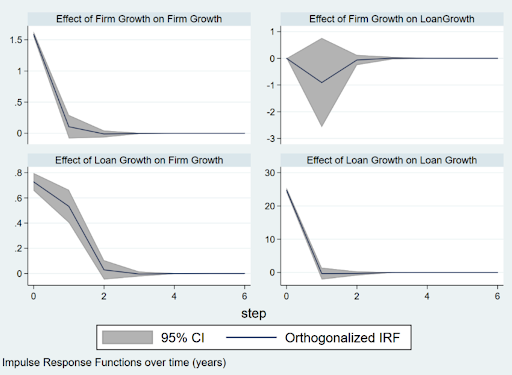
Effects of Small Loans on Bank and Small Business Growth
(Grantor: Small Business Administration )
We conducted a comprehensive study for the U.S. Small Business Administration (SBA) to evaluate the life-cycle dynamics of banks and the causal impact of credit availability on small business growth. Our methodology synthesized massive longitudinal datasets, including FDIC Call Reports, Community Reinvestment Act (CRA) data, and Business Dynamics Statistics (BDS), to track the transition of banks across size brackets and analyze regional economic performance. We utilized Markov transition matrices to document a significant decline in banking industry dynamism and applied a panel Vector Autoregressive (VAR) model with Impulse Response Functions (IRFs) to establish causality between small business loan supply and regional employment growth. Our findings demonstrated that small business loans—particularly those under $100,000—are critical drivers of both small bank asset growth and small business job creation, providing a rigorous empirical basis for policies aimed at maintaining credit supply in an increasingly consolidated financial market .
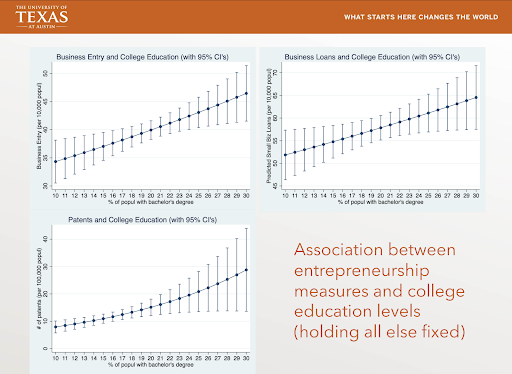
IC2 Rural Entrepreneurship
(Grantor: University of Texas at Austin IC² Institute, in partnership with Prof Junfeng Jiao and Prof Jason Abrevaya)
In collaboration with researchers from The University of Texas at Austin, our team developed a data-driven online platform to evaluate the entrepreneurship environment across the State of Texas, with a specific focus on rural regional dynamics. Our methodology synthesized massive longitudinal datasets spanning 1990 to 2018—integrating records from the Texas Comptroller, U.S. Patent and Trademark Office, and the Community Reinvestment Act (CRA)—to track key metrics such as firm entry rates, small business loan availability, and patent awards per capita. We employed exponential regression models incorporating county and year fixed effects to identify the structural determinants of entrepreneurship, finding strong positive associations between college education levels, median household income, and regional startup activity. This platform provides a rigorous evidentiary framework for policymakers to rank and assess the factors driving economic vitality across all 254 Texas counties.