
Cost Benefit Analysis
Strategic Decision Support through Cost-Benefit Analysis
At the core of informed investment and policy-making is the ability to weigh short terms vs long term costs against societal and economic gains. Our team provides rigorous Cost-Benefit Analysis (CBA) that moves beyond simple arithmetic to capture the nuanced "but-for" scenarios essential for high-stakes decision-making. We identify the hidden trade-offs in complex systems—whether evaluating the financial viability of emerging production methods, the welfare impacts of new regulations, or the ROI of public-private partnerships. (Campbell, H. F., & Brown, R. P. (2022). Cost-Benefit Analysis: Financial and Economic Appraisal Using Spreadsheets. Routledge.)
Our Analytical Capabilities
We utilize a multidisciplinary toolkit to convert theoretical questions into empirical certainty:
- Policy & Regulatory Impact: We develop computable partial-equilibrium models to analyze the long-term consequences of taxes, subsidies, and civil enforcement on industry dynamics and market prices. (Hopenhayn, H. A. (1992). "Entry, exit, and firm dynamics in long run equilibrium." Econometrica.)
- Production & Scalability Analysis: Our team deconstructs Cost of Goods Sold (COGS) to find the minimum efficient scale of production. We benchmark emerging technologies against mature industry leaders to identify cost-saving trajectories and supply chain bottlenecks. (Tirole, J. (1988). The Theory of Industrial Organization. MIT Press.)
- Social & Environmental Valuation: We apply an ecological economics paradigm to quantify "soft" benefits—such as improvements in public health, social capital, and city brand equity—that traditional financial models often overlook. (Atkinson, G., & Mourato, S. (2008). "Environmental Cost-Benefit Analysis." Annual Review of Environment and Resources.)
- Automated Estimation Frameworks: By standardizing forensic economic procedures into algorithmic tools, we provide fast, objective, and transparent assessments of financial gains or losses, reducing the "hired gun bias" inherent in traditional expert testimony. (Pasquale, F. (2019). "A rule of persons, not machines: the limits of legal automation." George Washington Law Review.)
Whether you are looking to invest in new infrastructure, produce using a novel technology, promote a specific industry, or impose regulatory standards, our analyses provide the data-driven defense required for success. We synthesize massive, disparate datasets—from US SEC filings to local community surveys—to ensure your strategy is grounded in regional reality and macroeconomic foresight.

Plant based Meats Cost of Goods Sold Analysis
(Client: Food Systems Innovation Research Fund)
We conducted an advanced cost-benefit and scalability study for the Food System Research Fund to quantify the economic impact of scaling plant-based meat alternatives (PBA) to meet global demand. Our team utilized a rigorous deconstruction of Cost of Goods Sold (COGS), analyzing the interplay between ingredient specialization, capital expenditures for extrusion technology, and labor efficiencies at the minimum efficient scale (MES). By synthesizing a massive multi-national database—including US SEC filings and UK financial registries—we benchmarked emerging PBA firms against mature food industry leaders to isolate potential cost-saving trajectories. Our analysis predicted that maturing production techniques could yield consumer price reductions of 25–30% while identifying critical bottlenecks in the agricultural supply chain for non-soy protein sources. This study provides stakeholders with a data-driven defense of the long-term cost-competitiveness and environmental value-add of alternative protein infrastructures.
Animal Farming Supply Chain Analysis
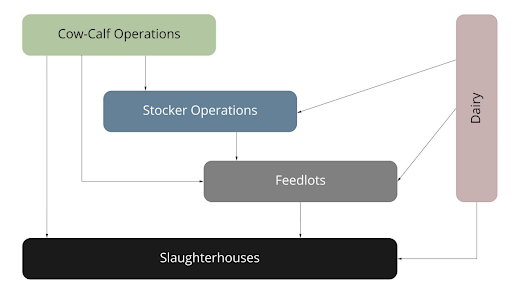
A large non-profit sought IAMECON's services to better understand the US factory farming supply chain. Our team located, collected, and merged diverse data sets into a comprehensive directory of over one hundred thousand key businesses operating in the supply chain, visualized it in Tableau Maps, and conducted statistical analyses that enabled our client to better understand the industry dynamics and reach their audience in a more efficient way. In a different study for the same client, we developed a computable Markov-perfect partial-equilibrium model of the US cattle farming industry to endogenously analyze the long-run impacts of regulatory policies on market dynamics. The computational framework simulates a competitive environment where heterogeneous firms—categorized into responsible and concentrated production sectors—manage dynamic decisions regarding entry, exit, and capital investment while facing idiosyncratic productivity shocks. Our work involved a rigorous calibration process using comprehensive data from the USDA Agricultural Census, the USDA Agricultural Resource Management Survey (ARMS), and longitudinal census microdata to estimate deep parameters such as factor elasticities, span of control, and sector-specific cost structures. To achieve high empirical accuracy, we utilized linear regression to fit an AR(1) process to historical residuals, identifying the persistence and variance of productivity shocks within each sector. This robust modeling tool enables researchers to run complex counterfactuals to measure the effects of internalizing environmental and public health externalities on equilibrium prices and industry-wide output.
Plant based Meats Customer Success Analysis
(Client: Food Systems Innovation Research Fund)
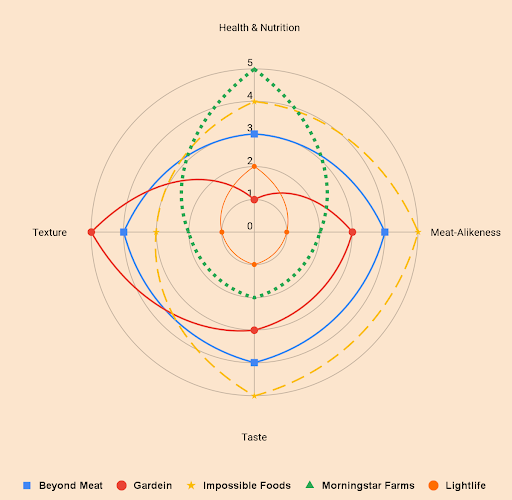
We provided a specialized economic analysis for the Food System Research Fund to quantify how consumer sensory perceptions, extracted from massive unstructured text data, influence the commercial success of plant-based meat alternatives (PBA). By synthesizing a large-scale database of 64,872 customer reviews across 267 products with comprehensive retail sales data, our team utilized cutting-edge Transformer-based models (GPT-3.5 and BERTopic) to decompose average ratings into specific sensory aspects such as taste, texture, and "meat-alikeness". Our predictive econometric framework, utilizing Poisson and Logistic regressions, demonstrated that a minor 0.1-point increase in average product ratings is associated with a 7.4% surge in sales volume, while discovering that negative sensory mentions are, on average, 8.7 times more impactful on consumer satisfaction than positive ones. This rigorous methodology provides manufacturers with a data-driven roadmap to identify and resolve the specific sensory bottlenecks limiting consumer adoption in the rapidly evolving protein market.