
Regulatory Impact Analysis
We Provide Analytical Power to our NGO and Governmental Partners
Our firm specializes in assessing market-wide impact of regulations or policy changes, both for past and proposed future policy changes.
Assessing impact of past policy changes most typically involves a before/after empirical analysis of variables of interest. Depending on the nature of the policy and its impact mechanism to modify market outcomes, our team uses statistical event studies, diff-and-diff estimators, and vector-autoregressive models to quantify the impact on variables of interest.
For predicting the impact of proposed (future) policy changes, we simulate the affected market segments within the industries of interest with and without the proposed policy change. Computationally, we first calibrate the model using historical data until the model is able to fit the key target variables of interest, and then simulate and compare market outcomes under the current (no policy change) and alternative (with policy change).
Both methods are supplemented with relevant academic literature, historical facts and evolution of industry dynamics, benchmarking the proposed change against similar past policy changes, controlling for scope, coverage, industry and impact channels, among others.
Our goal is to provide our clients with the best possible analysis for their problem, industry, and project scope. We perform scholarly research in order to offer our partners insights and solutions to their policy questions which are based on rigorous standards and methods. This also allows us to contribute the output of our research to the scientific community. Check out some of our projects below :
Pork Minimum Living Area Impact
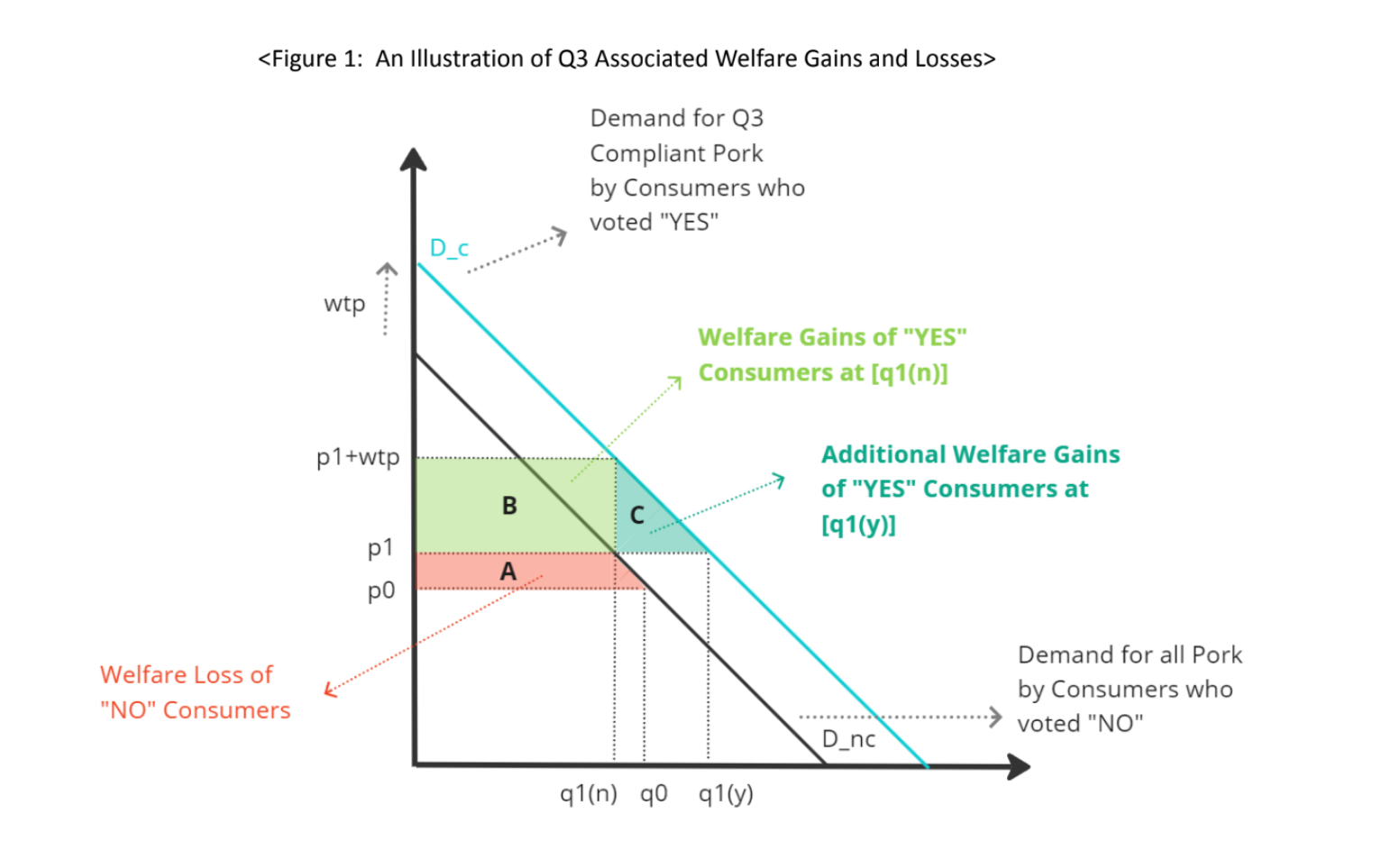
Our team has been hired by the Attorney General of Massachusetts to analyze the effects of the animal confinement-based sales restrictions set forth in Massachusetts' Question 3 on the overall market, producers, consumers, and interstate trade. In addition, our team has rebutted the economic analysis of agricultural economist Jayson L. Lusk. Our work utilized both economic theory and empirical simulations to quantify the impacts of Q3.

Cage-free Egg Regulatory Impact
Our team has worked on multiple projects assessing the price and supply impacts of cage-free egg regulations imposed around the nation, analyzed the transition of farmers from conventional to cage-free, supply shortages, avian flu episodes and grocery prices in conjunction with each other.

Capital One Branch Closure Analysis
For a legal dispute involving Capital One, our team has analyzed the welfare impacts of bank branch closures on bank consumers. We employed a micro-simulation at the consumer level capturing the in person interactions between consumers and banks, and estimated time value of bank branch distributions (geospatially) over resident populations.

Alternative Protein Labor Transition Analysis
(Client: The Good Food Institute)
We are currently working on a model of labor market transition dynamics between conventional protein industry and the alternative protein industry under the scenario of increased substitution of meat alternatives in the near future.

The Effects of Direct and Indirect Subsidies in the US Beef Industry (Client: Animal Legal Defense Fund)
We built a dynamic computable markov perfect equilibrium model of US beef industry along the lines of Hopenhayn and Rogerson (1993) in which we compute multi-sector dynamics (confined vs unconfined feeding operations) under policy interventions such as meat tax (environmental and public health), minimum space requirement or civil enforcement. (See Hopenhayn, H., & Rogerson, R. (1993). Job Turnover and Policy Evaluation: A General Equilibrium Analysis. Journal of Political Economy, 101(5), 915-938.)
Economic Analysis of the USDA’s Agricultural Marketing Service’s Organic Livestock and Poultry Practices (Client: Center for Food Safety)
We analyzed the economics behind the USDA’s Agricultural Marketing Service’s 2020 regulation regarding organic livestock and poultry practices, and analyzed its implications for producers and consumers in the short- and the long-term. Read more here.

Economic Analysis of Proposition 12 in California (Client: Humane Society of the United States)
Our team has conducted an analysis of the economic factors that should have been considered in order to properly assess the effects of Prop 12 on producers, consumers and interstate commerce.